Home Blog Page 184

Aquarium of the Pacific provides normalcy during times of struggle

0

The Aquarium of the Pacific in Long Beach adapts to COVID-19 guidelines while opening outdoor exhibits and providing an experience for visitors.

After being closed for three months, the Aquarium opened its outdoor exhibits when county and state regulations allowed it. 

Many new health and safety protocols were put in place to keep volunteers, staff, and visitors safe.

Nicole Meek is the director of visitor operations at the aquarium, and has worked there for 19 years. She is responsible for guest services, security, housekeeping, and the guest support center. 

 “All of our employees and volunteers who enter the aquarium every day have their temperature checked before entering and they’re completing a daily health survey,” Meek said.

The aquarium is also following all PPE guidelines by providing masks, gloves, face shields, hand sanitizer and hand washing opportunities to all staff. They even set up temporary sinks to provide more hand washing opportunities, and limited staff coming onsite to just essential workers.

The aquarium is also working with visitors who bought membership passes before the closing, as well as more perks for members. 

“We offer a 90-day extension to all active members to reflect the three months that we were closed. November is usually our member appreciation month, so we’re going to be doing some special exclusive member hours, developing a behind the scenes tour, and some other special online downloads for just members,” said Meek.

In order to visit the aquarium, visitors and members must make a timed online reservation, and expect to have their temperatures checked before entering the aquarium. Anyone age two or older must also wear a mask at all times unless they are eating. 

Even if visitors are hesitant to go in-person, the aquarium offers options to enjoy the animals from home. 

“We have webcams installed in six of our exhibits so that people can check out from home if they’re uncomfortable coming on-site, but we also have many programs available online [on our website] for people of all ages,” said Meek.

The aquarium also strives for providing a fun place for kids and a sense of normalcy during this time. 

“A fun thing for parents to know is that we are moving forward this year with a modified version of our annual ‘Scarium of the Pacific’ festival,” said Meek.

The event will take place for three days from Friday through Sunday, Oct. 23-25. Kids are encouraged to dress in their Halloween costumes, and staff will be in a costume for the occasion as well. The aquarium will also have pumpkins and other Halloween decorations in the outdoor exhibit area.

“We’re all kids at heart here so many of us take the opportunity to wear costumes during this festival,” Meek said.

Claire Atkinson, the senior manager of communications, said the aquarium is ready and prepared to open indoors when regulations allow them to do so.

“We’re ready to handle an experience like that. We were open briefly in June, so we had all those protocols in place. So we’re kind of a step ahead. We’re ready to go as soon as we get the go ahead to reopen the indoor area,” said Atkinson.

As for right now, the aquarium’s outdoor exhibits and gift shop are open. Visitors can see the sea lions, penguins, shark and ray touch pool, the lorikeets, and more.

The Aquarium’s indoor exhibits remain closed for now, such as the main lobby area that features their large to-scale blue whale. Photo by Jacqueline CrochetViking News

Letter to the editor: Prop. 15 invests in the state’s workforce via community colleges

0

California’s community colleges are among our state’s most important public resources, providing higher education for 2.1 million students annually. The system is the largest provider of workforce training in country.  Nearly one in four community colleges students in the country is a California Community College student. It’s the equity epicenter of California’s world leading higher education system. The majority of students of color in our state’s higher education system are enrolled in one of our 114 community colleges.

Standing in the way of this tremendous success is the greatest fiscal crisis facing our colleges since The Great Depression. COVID-19 has already decimated state revenues, and unfortunately the pandemic’s harm to students is being exacerbated by an antiquated tax system that for decades has rewarded large, older corporations while siphoning off billions of dollars from public education.  Fortunately, this November, Californians can help prevent disaster by passing Proposition 15, which will close corporate tax loopholes so we can reclaim $12 billion annually for community colleges, K-12 schools, and local public services – all while protecting homeowners and renters, small businesses, and agriculture.

Prop. 15 invests in our community colleges by ending unfair tax loopholes benefitting California’s wealthiest corporations, while at the same time cutting small business taxes to help rebalance the scales for those hit hardest by this crisis.

Prop. 15 is a unique opportunity for Californians to help reshape the way our community colleges, K-12 schools, and vital community services are funded, and to continue to deliver not only on the promise of a quality education made to our students, but on the outcomes those students provide that benefit all Californians. 

State taxpayers receive $4.50 in benefit for every $1 invested in students who earn a degree or certificate from a community college, and the system’s graduates double their own earnings within three years. California community colleges train most of the state’s first responders, firefighters, nurses, early childhood educators and essential workers. 

In the wake of this pandemic and with the support of more funding through Prop. 15, California’s community colleges will play a vital in the economy recovery of the state by training and educating the workforce of the future.

Prop. 15 will not only reclaim billions in badly needed revenue, but it will restore fairness to a tax system that currently favors some of the state’s largest, oldest, and wealthiest corporations. An analysis of Prop. 15 showed that only the top 10% would generate 92% of the revenue, illustrating the fact that only a handful of top corporations have been benefitting from these loopholes in the first place. This unfair advantage comes not only at the expense of these other businesses and property owners, but at the expense of millions of California students.

Investing in community colleges by voting yes on Prop. 15 will pay off for many Californians now more than ever. As large numbers of the young and older adults who make up our student population struggle with severely impacted incomes because of the pandemic, community colleges providing affordable, yet top quality education can offer a very attractive alternative to more expensive higher learning institutions. For many, two years at one of our excellent community colleges may be a far more equitable and viable way to begin the path to a four-year degree or to complete job-launching technical career training. In this unforeseen time of economic uncertainty, for some it will be the only alternative, the only way to continue with their education.

The ask of Prop. 15 is small, and the benefit to all Californians will be great. In addition to the support for our community colleges and the investment in smaller class sizes and resources for K-12 schools, Prop. 15 will invest in essential workers and local services that include the health care workers and other first responders who have helped so many continue on through this pandemic.

Linda Wah is the Immediate Past President of the California Community College Trustee Board and serves as a Trustee at Pasadena City College.

Uduak-Joe Ntuk is the Vice President of the Long Beach Community College District Board of Trustees and is the first African American male to serve on the college’s board of trustees since 1927.

Workshop teaches students to spot and prevent human trafficking

0

The Office of Student Affairs hosted an event called Human Trafficking 101, in which there were 65 attendees, as part of the Sexual Violence Prevention and Education Workshop Series.

October is Domestic Violence Awareness Month. 

Stephanie Ramos, Human Trafficking Coordinator at YWCA, was the host of the event. She covered basic terms used to describe human trafficking, statistics on victims each year, forms of human trafficking, and prevention tools. 

Some signs to notice from students who are victims of human trafficking could be a change in their school attendance, deameanor and attitude, and branding. Branding can include specific tattoos that pimps use to identify the women they are pimping. 

Other signs are having refillable gift cards, owning multiple phones and social media accounts, third-party control of schedule, unexplained bruises and sexually provocative pictures on a phone or computer are some few examples. 

A pimp is often used to describe a person who is using women or men to form human trafficking.

There are three types of pimps. 

The “CEO pimp” is like a businessman and does cherry-picking. This may include posing as an agent and promising aspiring models or actors with management and contracts. 

A “Romeo pimp” is someone who dates women and uses charm to take victims. 

“Gorilla pimps” use violence, kidnapping or blackmailing to control victims.

Ramos said that human trafficking victims often include vulnerable populations such as runaways, homeless youth, undocumented workers, LBGTQ+ individuals and people with disabilites. 

Traffickers will often use social media sites such as Instagram, Kik, Tinder, Plenty Of Fish, Meet Me, and Diamond Link to seek potential victims. 

Ramos said that when human trafficking victims are apprehended by the police they tend to be tried as prostitutes instead as a human trafficking victim, and oftentimes they are not given the proper sources to seek a way out.

The legal system is not working in favor of victims, said Ramos. 

“What we see lacking is a taking sexual violence and abuse as serious,” said Ramos. “More laws need to be out into place to protect victims who have committed crimes because a lot of victims are forced not only to sleep with 30-35 people a day but to commit crimes such as selling drugs.”

YWCA offer free service for human trafficking victims such as a 24-hour hotlime, accompaniment, advocacy, case management, and counseling. 

Ramos said, “If you’re going to go out, make sure to tell someone like friends or family. Share your location with someone you trust, be aware of your surroundings and avoid accepting drinks from someone you don’t know.” 

She also said that oversharing sometimes can work against you, and your vulnerability can be taken advantage of. She recommended reaching out to school resources if you need someone to talk to. 

“Create a plan if you walk home alone so your family or friends know what route you are taking,” said Ramos.

Sylvia Garcia, a student conduct specialist at LBCC said, “The topic of human trafficking is important. It’s often referred to as the silent killer because it happens around us and we may not be aware of it. We want to give our students that information to avoid putting themselves in those situations.”

This is the first qualifying event out of 5 that students can attend in order to receive a certification of completion from YWCA. To earn a certification students must attend at least 3 out of the 5 marked with a purple ribbon as shared in the flyer.

In deciding to present this information to students, it was not from a report or concerns raised by any particular person or group of people, said Garcia. 

“We want to plant seeds to help recognize and raise awareness,” she said.

Sergio Grimaldi, Healthy Viking coordinator said, “The goal is to prevent and be proactive. As the name suggests, Sexual Violence and Prevention and Education Workshop, we want to be preemptive.”

Human trafficking is a $150 billion-a-year global industry. According to the Labor Organization there is an estimated more than 24.9 million human trafficking victims. 

YWCA is an organization who aims to eliminate racism and empower women. Over 160 years, the organization has worked to improve the lives of women, girls and communities of color through advocacy, local programming and services.

If you are a victim of human trafficking please reach out for help at the YWCA 24-hour hotline at 1-877- 943-5778. You can also contact the LBCC Student Health Services at (562) 938-4210.

Review: Can Tannenberg stand up against its counterparts?

0

Correction: This article was updated to change the image.

World War 1 is an obscure era in history. It had a few offshoot movies and a few video games, but it is largely overshadowed by the Second World War. What’s even more obscure, are the tales from the Eastern Front. 

“Tannenberg” is a part of a two-game package, “It” and “Verdun,” portraying the Western and Eastern fronts of World War 1. “Verdun” was released in 2015 and “Tannenberg” in 2017 on PC. They were both developed by Blackmill Games and published M2H games. 

Tannenberg covers the Eastern front of WW1, although it doesn’t play as fast as its trench rushing half, “Verdun.” This is for a few reasons, console limitations being the main cause. But this is something I’ll get into later. 

Right now, let’s focus on the question: How does “Tannenberg” differ from “Verdun”? 

In “Verdun,” the battle took place along vast trench lines, where each side attempts to attack and defend. Whereas in “Tannenberg,” the teams fight to capture and defend flags in order to control the battlefield. When playing online, the game holds 40 players with bots making up the difference. This game aims for historical accuracy, as its Steam page reads, “With uniforms recreated to the tiniest detail and weapons modelled to exact references.” 

With this in mind, the game plays much slower for it. 

You fight mostly with long bolt action rifles. Each shot takes a while to aim to shoot, but each shot could be death, so a gunfight can end pretty quickly. Entrenched machine gun nests in particular are absolutely devastating if you’re on the receiving end. 

The engagements are dynamic, from forest skirmishes to rushing or defending flags. Though the gameplay is slow, it’s still engaging and even deadly. The guns are heavy, hit hard, and fire slow, especially the entrenched machine guns, which are capable of mowing down dozens of charging infantry. 

Its only weakness is the graphics, which have been downgraded compared to “Verdun.” It has really good looking character models and rifle designs but also a really short render distance. 

This applies to the environment as well but commendably, these locations look similar to their real-world counterparts. You lose details on the model the further out you are from a given object which means most of the targets you’re shooting at are non-descript claymen. 

This hurts the atmosphere the game drives for, which consists of blood, mud, and screaming. This game drives for that immersion and it comes across in its sound design, explosions ring out, machine guns roar, and men yell as they charge headlong towards it. 

Another problem is the AI count. It’s rare for a shooter on console to actually have bot modes. They add life to potentially dead games. But the number is really low if you solely play with bots, capping out at 24, including the player. These maps shipped with 64 players or AI to start on PC. 

Because of this difference, the maps play slower on a console. And there can be a good chunk of time between firefights, which happens often unless you move towards the middle of the map. 

The AI isn’t very smart either, sometimes they follow you as squad leader, but pretty often they decide to go literally anywhere else. The enemy AI, on the other hand, is solid, putting up a good fight, sometimes killing you before you’ve seen them.

It has a solid amount of content for the asking price, assuming you like what’s offered. 

Finding filled lobbies with only players doesn’t happen. Though, you can find 40 player matches that are fluffed with bots at certain times of the day but, it’s also rare.

Another problem with Tannenberg, which was also a problem in Verdun, is that only one mode has bot support. For both, it’s the main big team modes; Frontlines for Verdun; and Maneuvers for Tannenberg. 

But variety is the spice of life, and it breathes that much more life into the game. Bots are a large part of the sale here after all, being one of the few console shooter games to have it. To add to this it is a game of decent quality. In most shooters with AI, you will find they are usually very basic aimbots or are barely functional, getting stuck on the terrain often. 

Its large team mode is extremely fun when there are matches to be found. And forget about playing the smaller modes, the player base is sparse. The AI count doesn’t match the map size but functions well enough, with competent but slow combat. When you can do a full match, the game really comes into its own.

This is a niche title for the history enthusiast or tactical shooter fan. It is for people who don’t mind, or even enjoy, bot modes like myself. The industry is shifting towards more multiplayer, online-centric games, so “Tannenberg” is a good counter to that trend. 

The faults of this game on the console are limitations of the aging console hardware and not the core of the game. But it’s solid nonetheless.

Finding coping strategies during difficult times

0

Correction: The image’s caption was updated to clarify the image’s source.

Correction: Image updated to fix cropping.

On October 8th, LBCC Mental Health Clinician and Student Health Services advisor, Brianna Reyes, held an online workshop discussing specific techniques to cope with hardships due to the coronavirus pandemic.

The workshop was held in a Zoom meeting at 2:30pm and provided viewers with videos, a PowerPoint presentation, and Reyes’ own insights about coping techniques to alleviate negative thoughts and emotions.

A lot of information had mainly touched on subjects relating to symptoms, things to be cautious about, and coping strategies.

Some common symptoms of anxiety and depression are present in most individuals who suffer from a lack of productivity or exercise from the stagnation created by the pandemic.

Because stress from anxiety and depression are harmful to the mind and body, it is important individuals adopt a more positive perspective, which are improved by many of the given coping strategies like breathing exercises.

LBCC student, Katherine Miller, uses some coping techniques that were mentioned from Thursday’s meeting. 

Miller says she sometimes has trouble dealing with bad thoughts or feelings, so she usually walks her dog as a form of diversion from thinking about her pessimistic thoughts.

Miller said, “If I’m having a negative thought, a way to really wire that thought to something not so negative; not jump to conclusions.”

“Walking my dog and being outside helps me focus on something else that’s not my thoughts. It’s nice to be outside and get fresh air and stuff. I feel like that helps break up the monotony that Covid can throw upon you; break up the day, do something different,” Miller shared.

Another LBCC student, Sophia Cobb, says she can relate to Miller as she had also used some common coping strategies. Cobb also uses diversion methods to calm herself down in times of stress.

“I do try to find ways to distract myself from boredom, from anxiousness. One of the ways I would do that would be cooking or just making art, or listening to music. Finding ways to distract myself,” said Cobb. “It kind of calms my nerves sometimes. It’s kind of like a de-stress kind of thing.”

Reyes has also added that another workshop will be held on the 22nd, which will mainly go over topics discussing ways to connect socially during times of high-stress.

Opinion: Abortion access should be provided by California community colleges

0

California community colleges must follow the lead of U.C.s and CSUs and provide medical abortions to their students.


Following the 2019 decision that will provide abortion access to students at public California universities by 2023, a huge need is left unmet by neglecting community college students in this decision.

LBCC Student Health Services declined to comment regarding the feasibility of this at LBCC, saying there has not been any thorough conversation at this point.

Particularly during an administration that continually threatens protections for reproductive rights, this decision would provide support to students along with recognition that abortion access is a necessary health service.

Community colleges in California serve over 2 million students, who are particularly impacted in terms of resources and personal income compared to CSUs and UCs.

An attack on abortion rights largely impacts those who are mostly marginalized, generally those who are low-income and people of color, and community college students are largely comprised of these groups. 

Lack of abortion access for students creates a barrier to education, which community college students already experience at a greater extend than students at four-year-institutions. 

At LBCC, 56% of students can be considered low-income as indicated by their receipt of the Federal Pell Grant Aid.

The demand for this service at community colleges has been steadily increasing alongside enrollment rates, with studies demonstrating that college enrollment has increased over the past 20 years, largely including lower-income students and students of color. 

Furthermore, this leads to a far higher amount of students living in poverty compared to in previous decades. In fact, according to a 2016 study, 24% of CSU students could be food insecure. Similar data is unavailable for community college students, but the rates are estimated to be even higher due to the increased accessibility of two-year schools.

Considering the vast amount of students specifically at community colleges already in or nearing poverty, being denied an abortion is likely to further amplify this financial stress, adding further obstacles to college graduation. In fact, lack of abortion access is linked to lack of college completion.

This need is particularly pressing for community college students, as community college students already take longer to graduate on average than at four-year-institutions. For instance, for students that began at LBCC in Fall 2016, only 6% of full-time, first-time students graduated or transferred out within “normal time” to complete their programs. 

Community college students often stray from the typical “four-year-degree” college path that is widely normalized, with unique life circumstances and barriers that can often delay or prolong the pursuit of a degree.

Providing safe abortion access to all college students will ensure a more equal opportunity to pursue one’s degree. 

Even though abortion is currently protected under California’s state Constitution, as of 2017, 40% of Calif. Counties had no clinics providing abortions, according to Guttmacher, demonstrating the restrictions and and inaccessibility that exists dispite legal protection.

For students experiencing an unwanted pregnancy and unable to get an abortion, or who have to spend time finding access to one off-campus, these stressors can be eliminated by providing access on campus grounds. 

Providing safe, accessible abortions would help reduce these barriers, providing a safer, more supportive learning environment that all students deserve.

A course at Long Beach City College examines climate change

0

Students at Long Beach City College are studying the effects of climate change, many of which California is already experiencing, including heat waves, wildfires and rising sea levels. 

In the course “BIO 11 – Environmental Problems of Man” students are introduced to the reality of an uncertain future as they discuss plastics in the ocean, pesticides present in the food chain, and the availability of fresh drinking water. 

Class discussions revolve around the interconnectedness of biological life cycles. 

The course looks at not only one aspect of environmental pollution, such as how plastic affects marine life, but it also takes a look at the production of the plastic, and the emissions produced in transportation.

“When talking about climate change, we can’t just talk about one thing,” said LBCC professor Elizabeth Nash, who teaches the course. 

“We must understand that scientifically speaking, everything is connected. Climate change will affect poor people the worst, but everyone will be affected,” she said.

The course discusses environmental disparities on which communities are affected most by pollution. 

The term “environmental racism” is used to describe how the burden of environmental pollution tends to affect low income people and especially communities of color. 

Students of the class expressed some of their concerns. One student mentioned that they lived near local sources of air pollution, by a freeway near the ports.  Another student mentioned how communities are affected by asthma from the pollution emitted by boats and cars.

The class agreed that they believed society will need to make major changes in a short amount of time to effectively deal with climate change. 

“Society can’t be so capitalistic if we are going to survive,” said Said Pena, whose comment evoked support from classmates. 

“It’s up to our generation to take actions both in community and in politics,” said Christopher Varela as the class discussed how climate change begins at a local level.

Discussions around equity, human population, consumption of resources are often pitted against the goal of keeping global temperatures stable.  According to the professor, her goal is to ensure that students develop an understanding of how issues around the environment are interrelated, economics, social progress, equity are heavily connected to the effects humanity has on the environment.

Brazilian Jiu-Jitsu during a pandemic

0

While Brazilian jiu-jitsu is a sport, it is also a business impacted greatly by COVID-19, as businesses have been forced to either restructure or close completely, and martial arts studios were no exception.

CheckMat is an academy and competition team of Brazilian jiu-jitsu. The academy was founded in 2008 and now has grown on an international level. CheckMat now has over 30 affiliate academies in the United States and is in 16 countries worldwide. 

CheckMat is founded by Master Leo Viera, and is located at the main headquarters in Signal Hill, California.  

When the United States originally had its first quarantine shut down one of the first places that was mandated to shut down were gyms, and independent martial art studios were no different. 

Many jiu-jitsu studios were forced to close completely because it was too difficult to keep up with the rent with no income coming in, or some studios were unable to work something out with the landlord when they were mandated to shut down. 

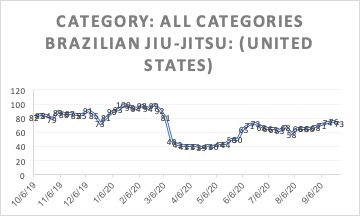
Source: Google Trends

Since the original quarantine shutdown that happened in March, there has been a significant decline in interest in Brazilian jiu-jitsu in the United States, that the industry has yet to recover from. 

On May 8, Vieira sat down with martial arts school Combat Creative to discuss Jiu-Jitsu during COVID-19, and what it means for jiu-jitsu in the future. 

Vieira said, “My commitment is to make my school and my team safe, you know. So, I control my mats and I’m responsible to have people who come here to be safe. In a situation like this I support health and I’m not supporting like you know like crazy stuff.” 

Vieira also said on his eventual re-opening, “I will never take the free will of our affiliation for our students to choose what to give them. So, when we reopen they’re gonna be able to choose what kind of class they want to enjoy and that’s, I think, why we learn so much of jiu-jitsu, it’s about respect.” 

CheckMat is now offering in-person classes  with safety measures such as  temperature checks at the front door. 

To create more accessibility for the kids in the academy, CheckMat is offering online recordings and Zoom classes. They are also letting kids borrow equipment for their zoom classes since many don’t have the proper equipment at home. 

Marcelo Santos, who works at CheckMat said, “I think it’s been really good to offer classes for the mental health of people, you know. I also feel like we help people to start exercising, they’re not just at home you know, they’re moving themselves and feeling better even about like anything because right now all we see is negativity.” 

Santos also said, “Another thing that I feel is that more people are looking for Jiu-Jitsu because there is no baseball for kids, there is no basketball, there is no soccer they can’t find anything for their kids and they find a place that is offering a safe environment.” 

Santos commented on if he thought COVID-19 would make a permanent impact on jiu-jitsu, or if he believed things would go back to normal. 

Santos said, “It’s going to make a lasting impact with those who had to close. Those people lost their school and their job, right? I know people from other parts of the country that had two schools and had to close everything and find a job at like a Walmart and stuff because they just had to get a job.” 

“I believe it’s going to get back like there’s people who like it. There’s a website called the JJA that’s just selfcare and they have like thermometers and like masks, everything that you can think about this whole thing, like hand sanitizer, so people will get used to these protocols,” said Santos.

CheckMat and jiu-jitsu studios are committed to creating a safe place for people to still be able to stay healthy and active. Brazilian Jiu-Jitsu studios like CheckMat have shown they plan to survive during the pandemic.

Online classes vs in-person classes

0

Correction: This article has been updated to correct the photo illustrator’s name.

The world today has changed due to the pandemic and lockdown of COVID-19, one of its biggest changes being how classes are held. 

While some states and cities have reopened various schools with safety precautions, most classes are still being held virtually.

However, some students have said they’d prefer classes happen in-person rather than online because they feel more focused and active while they are in a physical classroom. 

It’s no doubt that some students would prefer sitting in a physical classroom instead. There are less distractions around and your main view is the front of the classroom, which allows for more convenient access. 

Andrew Garcia, a current student at Long Beach City College, has found finding motivation for his work more challenging since online learning began.

“When we first started online classes, I thought it would be easier,” Garcia said, “But over time, I’ve just had less motivation to start or finish my work because I’m just used to staying at home all day now.”

Being at home and staring at a computer screen for several hours a week can cause discomfort and boredom for some, making completing schoolwork all the more challenging.

However, college and high school students aren’t the only ones who have felt this way. 

It also occurs with elementary students as they are also taking the virtual approach in school.

When asked how his seven-year old son is dealing with online school, Chris Lewis, a Long Beach resident, provided his input.

“It’s a challenge for both of us, because he gets distracted easily when he’s usually very active and listening in class,” Lewis said.

“But he’s just so comfortable being home now, that online school for him is just like Facetiming his cousins or friends, and he’ll goof off once in a while,” he said.

Of course, students are still trying to adjust their lifestyles to online classes in the best way they can, with procrastination and laziness sometimes playing a role.

For now, students are continuing to adapt to the virtual substitution while others are anxious to return to physical classrooms, whenever the safest and most appropriate time approaches.

Are Viking athletes coming back?

0

A couple of weeks ago UCLA and USC were approved by the county to start training on their campuses after several months of absence due to COVID-19.

This allowed the athletes to begin their preparation for next year’s competitions.

In a recent interview with LBCC’s athletic director, Bill Husak, regarding the topic of UCLA and USC returning, he said “I think it’s great. I think it’s wonderful student athletes have a chance to come back, practice and play.”

But he also expressed how every institution has different regulations and a different process to meet requirements and guidelines for a safe environment for their students.  

When asked the question if LBCC’s athletes are coming back, Husak said “We hope we come back to practice and play in Spring. That’s the goal.”

However, this decision will depend on the health departments of the cities of Long Beach, Pasadena, and Los Angeles.

LBCC is already organizing a socialization plan, with the goal of a safe return for student athletes next semester.

The socialization plan is already being reviewed by the College.

Some of the highlights of the plan are testing student athletes through a checkpoint everyday, practicing social distancing, cleaning the equipment, no access to the locker room facilities, monitoring restrooms, and more.

Eduardo Nunes, coach of LBCC’s woman’s soccer team, said “All this time we’ve been off, we’ve been planning [for a safe return] and a lot of this has been done with the guidance of our teams’ trainers and doctors.”

A live conversation with Eduardo Nunes. Screenshot by Marcelo Osterloh.

Coach Nunes also said, “If we get the green light, I think we are going to be absolutely okay. I’d go in with 100% confidence.”

Due to 2020’s sports competitions cancelation, the 2020 Fall sports will be played in Spring 2021. Bill Husak said “All 18 sports will take place in Spring. Spring would be cut in half.”

The first half the semester would have around eight sports being played such as football, soccer, two aquatic sports, basketball and others. The second half would consist of baseball, softball, track and field, and more.

Spectators will not be allowed to attend those competitions. Only the athletes and coaches can be present.